
TL;DR — Three scoreboards, three different answers
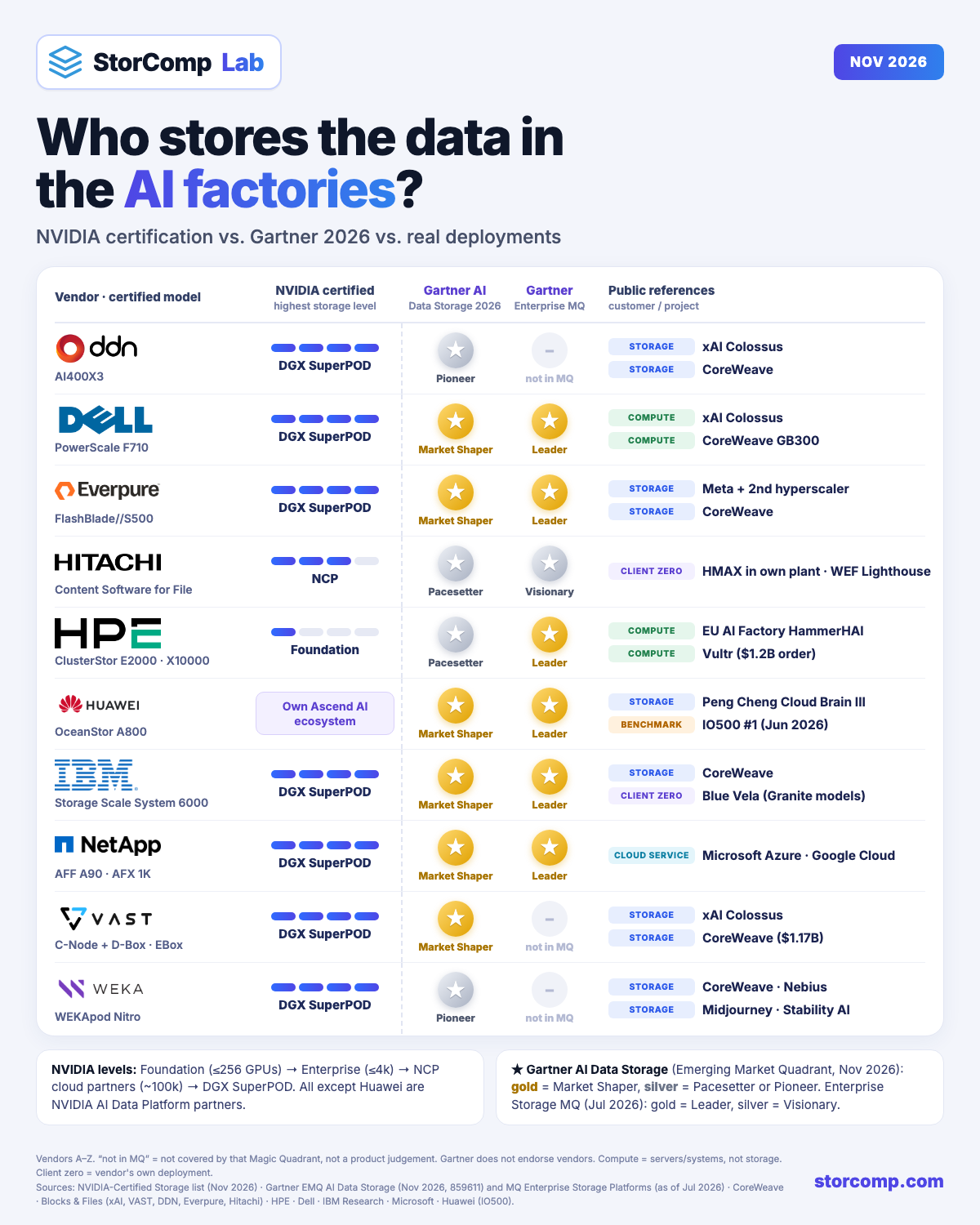
We mapped ten enterprise storage vendors against three scoreboards: NVIDIA’s storage certification for AI factories, Gartner’s 2026 rankings, and publicly named deployments. They do not agree.
- Seven vendors are NVIDIA-certified up to DGX SuperPOD: DDN, Dell, Everpure, IBM, NetApp, VAST Data and WEKA. Certification is now table stakes, not a differentiator
- Gartner’s new AI Data Storage quadrant names six Market Shapers: Dell, Everpure, Huawei, IBM, NetApp and VAST Data. DDN and WEKA, both fully certified, are placed in Pioneers
- Huawei sits outside NVIDIA’s programs and builds on its own Ascend AI stack, yet it is a Gartner Market Shaper and an Enterprise Storage Leader
- The largest AI factories run multi-vendor: xAI’s Colossus stores data on DDN and VAST; CoreWeave lists five storage vendors side by side
1. NVIDIA-Certified Storage: who is certified where
NVIDIA certifies storage at four levels. Foundation covers PCIe GPU servers up to 256 GPUs. Enterprise covers HGX reference configurations up to about 4,000 GPUs. NCP covers NVIDIA Cloud Partner deployments in the order of 100,000 GPUs. DGX SuperPOD is NVIDIA’s own reference architecture. Separately, the NVIDIA AI Data Platform is a reference design for storage that feeds AI agents and retrieval workloads.
| Vendor | Highest level | Certified file systems (NVIDIA list) | AI Data Platform |
|---|---|---|---|
| DDN | DGX SuperPOD | AI400X3, AI400X3i | Partner |
| Dell | DGX SuperPOD | PowerScale F710 | Partner |
| Everpure | DGX SuperPOD | FlashBlade//S500, FlashBlade//EXA (Foundation) | Partner |
| Hitachi Vantara | NCP | Hitachi Content Software for File | Partner |
| HPE | Foundation | ClusterStor E2000 (file); Alletra Storage MP X10000 (object) | Partner |
| Huawei | — | Not in NVIDIA programs; own Ascend AI ecosystem (OceanStor A800) | — |
| IBM | DGX SuperPOD | Storage Scale System 3500 and 6000 (formerly ESS) | Partner |
| NetApp | DGX SuperPOD | AFF A90, AFX 1K | Partner |
| VAST Data | DGX SuperPOD | C-Node Gen 6 + BF-3 D-Box; EBox reference designs | Partner |
| WEKA | DGX SuperPOD | WEKApod Nitro; WEKA Qualified Program Nitro and Prime | Partner |
Source: NVIDIA, List of NVIDIA-Certified Storage Systems, accessed 23 November 2026. Also certified: Cisco (Foundation to NCP), Nutanix (Foundation, Enterprise) and Cloudian (object, Foundation). AI Data Platform partners per NVIDIA GTC 2026 and launch announcements.
Two details matter when reading the list. Hitachi Content Software for File is built on WEKA’s file system. HPE’s ClusterStor is a Lustre-based HPC platform, while its X10000 was the first object-storage system certified at Foundation level.
2. Gartner 2026: two rankings, two different lines
Gartner published two relevant reports in 2026. The Magic Quadrant for Enterprise Storage Platforms (as of July 2026) ranks the broad enterprise market. The new Emerging Market Quadrant for AI Data Storage — Established Vendors (11 November 2026) scores 19 vendors on potential to execute and potential for market disruption.
| Vendor | AI Data Storage EMQ (Nov 2026) | Enterprise Storage MQ (Jul 2026) |
|---|---|---|
| DDN | Pioneer | Not covered |
| Dell | Market Shaper | Leader |
| Everpure | Market Shaper | Leader |
| Hitachi Vantara | Pacesetter | Visionary |
| HPE | Pacesetter | Leader |
| Huawei | Market Shaper | Leader |
| IBM | Market Shaper | Leader |
| NetApp | Market Shaper | Leader |
| VAST Data | Market Shaper | Not covered |
| WEKA | Pioneer | Not covered |
Other EMQ vendors: Nutanix and Scality (Pacesetters); Hammerspace and MinIO (Pioneers); VDURA, Cloudian, Qumulo, DataCore, Quantum and Quobyte (Specialists). Other MQ vendor: IEIT Systems (Niche Player). Gartner does not endorse any vendor.
- Market Shapers: most likely to drive substantial change in an emerging market
- Pacesetters: strong execution, more incremental innovation
- Pioneers: potentially disruptive, with go-to-market still to be proven at scale
- Specialists: smaller vendors with incremental, less proven innovation
Put next to NVIDIA’s list, the gap is clear. DDN and WEKA hold every NVIDIA certification and run in the largest GPU clouds, yet Gartner places them in Pioneers. Huawei holds none, yet it is a Market Shaper and a Leader. Four vendors appear at the top of all three scoreboards: Dell, Everpure, IBM and NetApp.
3. Public deployments: who actually runs where
Certifications and quadrants are scoreboards. Deployments are evidence. The table lists publicly named references for each vendor and what was supplied. “Client zero” means the vendor runs its own technology in production first.
| Vendor | Reference | What was supplied |
|---|---|---|
| DDN | xAI Colossus; CoreWeave | Storage |
| Dell | xAI Colossus; first GB300 NVL72 racks for CoreWeave | Compute (servers) |
| Everpure | Meta and a second top-5 hyperscaler (DirectFlash); CoreWeave | Storage technology and systems |
| Hitachi Vantara | HMAX in its own Norman, Oklahoma plant (WEF Lighthouse) | Client zero |
| HPE | EU AI Factory HammerHAI at HLRS Stuttgart; Vultr AMD Helios order ($1.2B) | Compute (systems) |
| Huawei | Peng Cheng Cloud Brain III; #1 on the IO500 list (June 2026) | Storage; benchmark |
| IBM | CoreWeave (Storage Scale); Blue Vela, where IBM trains its Granite models | Storage; client zero |
| NetApp | Native services in Microsoft Azure and Google Cloud | Cloud storage service |
| VAST Data | xAI Colossus; CoreWeave ($1.17B agreement); Lambda | Storage |
| WEKA | CoreWeave, Nebius; Midjourney, Stability AI | Storage |
Vendor and customer announcements and trade press; see sources below. CoreWeave lists VAST, WEKA, DDN, IBM Storage Scale and Pure Storage (Everpure) on its storage page.
The pattern is multi-vendor. xAI’s Colossus uses DDN and VAST for storage and Dell for compute. CoreWeave lists five storage vendors on one page. The biggest buyers treat storage as a portfolio, not a single badge.
4. What it means for buyers and partners
- Treat NVIDIA certification as a minimum. Check the level (Foundation vs SuperPOD) against the GPU count you actually plan to run
- Read Gartner positions as one input. A Pioneer can be the right choice for a GPU cloud; a Market Shaper can be the safer choice for an enterprise that also runs block and file workloads
- Ask for references at your scale, and ask what was supplied: storage, compute or a cloud service
- Compare lifecycle cost, power and density on a fixed horizon. At AI scale, watts per TB and rack units per PB move the budget
Compare enterprise storage platforms side by side on storcomp.com, vendor-independent. Part 2 of this series looks at how much storage EU and US AI factories need, and what their power costs.
Methodology and sources
- Snapshot as of 24 November 2026. Certifications and rankings change; check the linked sources for the current state.
- NVIDIA levels and model names come from NVIDIA’s certified storage systems list. “Highest level” is the top file-storage level at which a vendor has at least one certified system.
- Gartner positions come from the published Emerging Market Quadrant (as of November 2026, ID 859611) and Magic Quadrant for Enterprise Storage Platforms (as of July 2026) graphics. Gartner does not endorse any vendor and its research consists of the opinions of its research organization.
- References are limited to publicly named customers, vendor announcements and trade press. A missing reference does not mean a vendor has none.
- NVIDIA — List of NVIDIA-Certified Storage Systems — levels and certified models
- NVIDIA — Enterprise AI Factory Design Guide, ecosystem architecture
- NVIDIA — GTC 2026 announcements — AI Data Platform partners
- NVIDIA — AI Data Platform launch, March 2025
- HPE — Agentic AI with NVIDIA, June 2026 — X10000 object certification
- Gartner — Emerging Market Quadrant for AI Data Storage — Established Vendors, 11 November 2026
- Blocks & Files — Gartner spins up Emerging Market Quadrant for AI Data Storage
- Blocks & Files — Magic Quadrant for Enterprise Storage Platforms 2026
- CoreWeave — Storage for AI — storage partners
- Blocks & Files — VAST Data lands $1.17B CoreWeave deal
- Blocks & Files — DDN supplying storage for xAI’s Colossus
- Blocks & Files — VAST Data in xAI’s Frontier AI Factory
- Colossus (supercomputer) — Dell and Supermicro as server suppliers
- Dell — First NVIDIA GB300 NVL72 delivered to CoreWeave
- Blocks & Files — Second hyperscaler for Everpure’s flash technology
- Blocks & Files — Meta on Pure Storage DirectFlash
- Blocks & Files — Hitachi Vantara as customer zero for HMAX
- HPE — HammerHAI at HLRS and Argonne systems, March 2026
- HPE — $1.2B AMD Helios order from Vultr
- Huawei — OceanStor A800 tops IO500 — vendor announcement
- Blocks & Files — IBM Storage Scale in the Blue Vela AI supercomputer
- Microsoft — Azure NetApp Files for NVIDIA AI training and inference
- WEKA — Customers — Midjourney, Stability AI
- SemiAnalysis — ClusterMAX 2.0 — neocloud storage
Based on StorComp research from public and market-observed sources. Actual results and pricing may vary by configuration, workload, region, discounts and support terms.